Welcome to {{PROGRAM_NAME}}
Player education can be accurate and still go unread. This module introduces {{PROGRAM_NAME}} through two ideas: the Engagement Gap, which explains why people overlook player education, and the Knowledge Gap, which identifies what players need to know. You will learn how both shape the way we communicate.
Operator note: Replace
{{PROGRAM_NAME}}with your program name throughout. Adapt the engagement gap examples in Section 1 to reflect your operator’s pre-{{PROGRAM_NAME}} state if applicable. The Knowledge Gap concept and informed choice model in Section 2 are universal and should not be modified.
Program: All Employees | Duration: ~15 min | Prerequisites: None
Quick-scan index
| Section | What it covers | Time |
|---|---|---|
| Learning objectives | What you’ll know after this module | — |
| Section 1: The Engagement Gap | Why traditional RG content fails | ~5 min |
| Section 2: The Knowledge Gap | The gap between what players know and what they need to know | ~5 min |
| Section 3: The Two Pillars | Open and Social — what they mean | ~3 min |
| Module test | 8 graded questions, 80% to pass — that’s 7 of 8 | ~5 min |
| Key takeaways | Summary | — |
| References | Links to Playbook brand assets | — |
Learning objectives
After completing this module, you will be able to:
- Explain the two gaps that make traditional RG fail — and why {{PROGRAM_NAME}} closes both
- Use the four informed-choice premises to answer a skeptical colleague’s objection
- Spot which of the two pillars a piece of content serves — or whether it serves neither
- Define {{PROGRAM_NAME}} in one sentence to a brand-new hire
Why this matters: Because of you. The Knowledge Gap only exists if the information stays hidden — and you’re often the closest person to a player who needs it. If you can’t explain {{PROGRAM_NAME}}, you can’t close the gap. This module gives you the framework so you can.
Before We Begin
Think about this: What comes to mind when you hear “responsible gambling”? A helpline number in small print? A warning label? A compliance checkbox? Whatever your answer, hold that thought — we’re about to challenge it.
Section 1: The Engagement Gap
Reading
Think about the last safety video you tuned out or terms page you scrolled past. The information may have mattered, but the delivery did not earn your attention. Gambling education can face the same problem.
Most responsible gambling content fails. Not sometimes — systemically, across the industry. It fails in four specific ways:
Failure 1: Invisible. A helpline number in 8-point type at the bottom of a terms page. A “Play Responsibly” tagline after sixty seconds of adrenaline-fueled advertising. A self-exclusion option buried four clicks deep. The content is technically present. It is also functionally invisible.
Failure 2: Not engaging enough to educate. When the content is visible, it reads like a warning label — clinical, obligatory, and designed to satisfy a regulator, not reach a human being. Players aren’t patients. They’re customers who chose to spend their entertainment budget on something they enjoy.
Failure 3: Generic. The same boilerplate “Set a limit” prompt appears whether you’re betting on the Super Bowl or playing penny slots. The content wasn’t built for either player. It was built for a compliance checklist.
Failure 4: Disconnected from the brand. External RG programs arrive as a separate identity — different logo, different tone, different design language — and get bolted onto the entertainment experience like an afterthought. Players read the disconnect instantly.
These failures create the engagement gap: the distance between the quality of the entertainment experience and the quality of the educational content around it. Players notice when one part of the product was designed by a world-class team and another part looks like it was generated by a legal template engine. They notice, and they scroll past.
{{PROGRAM_NAME}} closes that gap. It treats player education as a marketing communications challenge — building content with the same creative standards, the same voice quality, and the same audience understanding that powers the entertainment product itself.
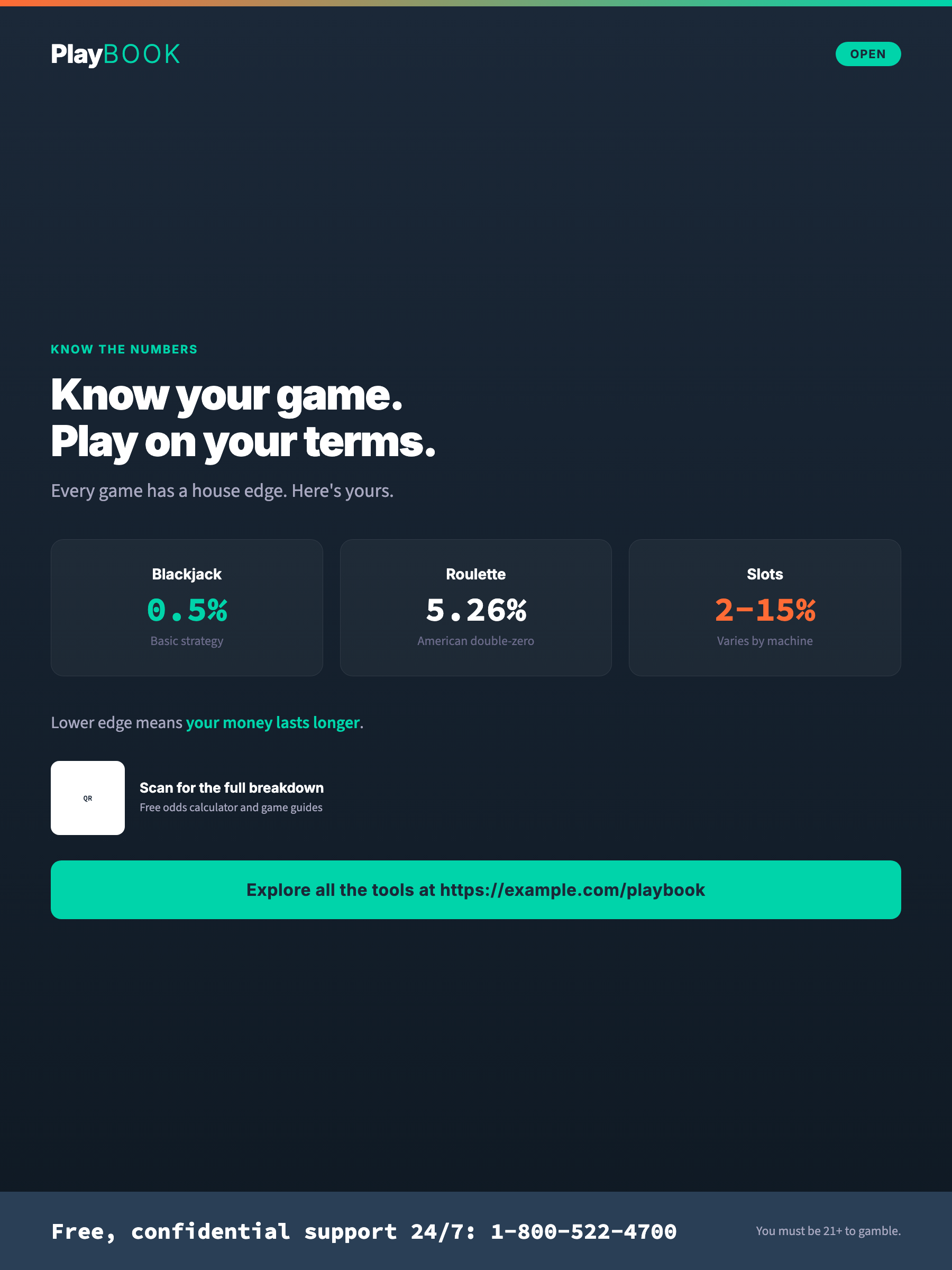
Narrator Script
Narrator: [transition slide] Let’s start with a question: when was the last time you actually stopped and absorbed a “Play Responsibly” message?
[pause 5s for learner reflection]
If you’re like most people, the answer is never. And that’s the problem we’re here to solve.
[show four-failures grid] The gambling industry spends billions making the entertainment experience compelling. But the educational material around it? It’s invisible, generic, clinical, and disconnected from the brand. That’s the engagement gap.
{{PROGRAM_NAME}} exists because player education hasn’t been treated as a marketing communications challenge. It’s been treated as a compliance checkbox. And checkboxes don’t change behavior.
[pause 2s] Quick exercise next — four examples, four failure types, see if you can match them. Take your time with it. When you’re done, hit play and we’ll keep going.
Exercise: Identify the Failure
Type: scenario
Instructions: Match each example to the engagement gap failure it represents.
| Example | Correct Category | Feedback (correct) | Feedback (incorrect) |
|---|---|---|---|
| “A helpline number in 6pt font in the website footer” | Invisible | Right — the content exists but no one sees it. | This example is about visibility, not tone or relevance. The content is present but functionally invisible. |
| ”Pursuant to regulatory requirements, the following responsible gambling information is provided for your review.” | Not engaging enough to educate | Correct — clinical, obligatory tone that reads like a legal document, not useful content. | This is about tone, not visibility. The content might be visible but it reads like a warning label. |
| ”The same ‘Set a limit’ prompt for a sports bettor and a penny slots player” | Generic | Yes — one-size-fits-all content that wasn’t built for anyone specific. | This is about relevance. The same message for every player type means it works for none of them. |
| ”An external RG badge with a different logo and design language bolted onto the operator’s homepage” | Disconnected from the brand | Exactly — players see the disconnect between the entertainment brand and the bolted-on RG identity. | This is about brand integration. External programs that don’t match the operator’s brand feel like afterthoughts. |
Section 2: The Knowledge Gap
Reading
The Engagement Gap concerns how content reaches players. The Knowledge Gap concerns what players need to understand.
The Knowledge Gap is the distance between what a player currently understands and what a fully informed player would know — how games work, house edges, game strategy, the real risks of play, and the tools available to manage it. Most players sit somewhere on this spectrum. Very few are at zero. Very few are fully informed. The Knowledge Gap is the space in between.
What the gap looks like: A regular at one casino played the same slot every Friday because it “hadn’t paid out in weeks — so it’s due.” Nobody had ever told her that every spin is independent and the machine keeps no score. After a short {{PROGRAM_NAME}} explainer on how slots actually work, she didn’t stop playing — she stopped waiting for a payout that was never scheduled, and started treating her Friday budget like the price of a night out. Same player, same game, better information.
Two gaps, one system:
| Engagement Gap | Knowledge Gap | |
|---|---|---|
| What it is | The distance between entertainment quality and education quality | The distance between a player’s current understanding and full informed play |
| Whose problem | The industry’s (supply side) | The player’s (demand side) |
| What causes it | Content that’s invisible, clinical, generic, and disconnected | Missing information about odds, game mechanics, strategy, risks, and tools |
| What solves it | Marketing-quality content ({{PROGRAM_NAME}}) | Informed choice — giving players the knowledge and tools they need |
The Engagement Gap is why players never see the content. The Knowledge Gap is what the content needs to close. {{PROGRAM_NAME}} solves both: it builds content good enough to reach players (closing the Engagement Gap) that teaches them what they need to know (closing the Knowledge Gap).
The informed choice model explains why the Knowledge Gap matters and how to close it. It has four premises:
Premise 1: Most people who gamble do so without problems. The vast majority of players gamble recreationally, within their means, and without difficulties. This defines our audience — we’re writing for the majority, not for a clinical minority.
Premise 2: Gambling is entertainment. It’s a leisure activity that costs money, like going to a concert or subscribing to a streaming service. We’re not warning people away from danger. We’re helping them get more out of something they’ve already chosen.
Premise 3: Information and tools support informed choice, but they are not sufficient on their own. This is where the Knowledge Gap matters: players should be able to understand how games work, what the odds mean, and what tools are available. Those conditions improve choice inside a wider system of safeguards and support.
Premise 4: Responsibility is shared. Players make their own choices — and that autonomy is respected. Operators provide accurate information and effective tools. Regulators set standards. Support services exist for those who need them. No single party owns all the responsibility.
The shape of it. {{PROGRAM_NAME}} is not anti-gambling — it respects that the vast majority of players gamble recreationally and enjoy it. It’s not clinical, not regulatory, not a substitute for professional help. It’s a marketing communications challenge solved as a marketing communications project. That’s the difference.
{{PROGRAM_NAME}} is a content and media brand — the educational and awareness layer that closes the Knowledge Gap by helping players understand how gambling actually works.
Narrator Script
Narrator: [transition slide] The Engagement Gap explains why players never see the material. But there’s a deeper question: what should the material actually teach?
[show Knowledge Gap spectrum] That’s the Knowledge Gap. It’s the distance between what a player currently knows and what a fully informed player would know — how games work, what the house edge means, what tools are available, what the real risks are.
[show two-gap comparison] Think of it this way: the Engagement Gap is the industry’s problem — the material isn’t good enough to reach players. The Knowledge Gap is the player’s problem — they’re missing information they need. {{PROGRAM_NAME}} solves both.
[show informed choice model] The informed choice model explains why the Knowledge Gap matters. [show premise 1] First: most people who gamble do so without problems. [show premise 2] Second: gambling is entertainment. [show premise 3] Third — and this is the key one — when people do run into difficulty, it’s usually because they lacked information or tools. That’s the Knowledge Gap in action. [show premise 4] Fourth: responsibility is shared.
[pause 3s] {{PROGRAM_NAME}} is not anti-gambling. It’s not clinical. It’s a media brand that closes the Knowledge Gap — helping players understand how gambling works so they can make informed choices.
[pause 2s] Sort the statements above into “is” and “isn’t.” The misclassifications people make on this exercise are the same misclassifications stakeholders make in real conversations, so it’s worth slowing down for. Hit play when you’re ready.
Exercise: What {{PROGRAM_NAME}} Is and Isn’t
Type: identify-issue
Instructions: Sort each statement into “What {{PROGRAM_NAME}} IS” or “What {{PROGRAM_NAME}} IS NOT.”
| Statement | Correct Category | Feedback (correct) | Feedback (incorrect) |
|---|---|---|---|
| “A content brand that helps players understand how gambling works” | IS | Correct — this is the one-sentence definition. | {{PROGRAM_NAME}} is exactly this: a content/media brand for gambling entertainment literacy. |
| ”A clinical resource that diagnoses gambling problems” | IS NOT | Right — {{PROGRAM_NAME}} doesn’t diagnose or treat. That’s what professional support services do. | {{PROGRAM_NAME}} is not clinical. It provides information and promotes tools, but it doesn’t diagnose anyone. |
| ”The educational and awareness layer of the gambling experience” | IS | Yes — {{PROGRAM_NAME}} is the education layer, built with marketing-quality standards. | This describes what {{PROGRAM_NAME}} is — the educational layer that sits alongside the entertainment product. |
| ”An anti-gambling campaign designed to discourage play” | IS NOT | Exactly — {{PROGRAM_NAME}} isn’t anti-gambling. It’s anchored in the idea that gambling is entertainment. | {{PROGRAM_NAME}} is not anti-gambling. It respects that most people gamble recreationally and helps them do it well. |
| ”Content built with the same creative standards as the entertainment product” | IS | Right — treating player education as a marketing communications challenge is {{PROGRAM_NAME}}‘s core approach. | {{PROGRAM_NAME}} is built to the same quality standard as the entertainment product itself. |
| ”A substitute for professional help when someone needs it” | IS NOT | Correct — {{PROGRAM_NAME}} provides information, not treatment. Professional support exists for those who need it. | When someone needs professional help, {{PROGRAM_NAME}} points them to support services. It doesn’t replace them. |
Section 3: The Two Pillars
Reading
Every piece of {{PROGRAM_NAME}} content aligns with at least one of two brand pillars:
Pillar 1: Open — “No fine print.” Transparency about how things actually work. The house edge, the odds, the T&Cs, the stuff nobody reads. If it affects a player’s experience, we tell them straight. Open means no hedging, no burying information, no fine print. It means treating players as adults who deserve to know how the games they’re paying for actually work.
Pillar 2: Social — “Worth sharing.” Content worth talking about. Quizzes, myth-busters, facts that make you the smartest person at the table. Share it. Challenge your friends. Start conversations. Social means the content is designed to travel — to be shared, discussed, and engaged with, not filed away and forgotten.
These two pillars are the first filter for every piece of content. Before writing, creating, or approving anything, ask: Does this make things more transparent (Open)? Does this make people want to share it (Social)? If the answer to both is no, it’s not {{PROGRAM_NAME}} content.
Narrator Script
Narrator: [transition slide] Now you know the framework. Let’s talk about what {{PROGRAM_NAME}} output actually looks like. Every piece we create aligns with at least one of two pillars.
[show Open pillar card] Pillar one: Open. The tagline is “No fine print.” This is about transparency — the house edge, the odds, how games actually work. If it affects a player’s experience, we tell them straight.
[show Social pillar card] Pillar two: Social. The tagline is “Worth sharing.” This is about making material that travels — quizzes, myth-busters, shareable facts. Material people actually want to talk about.
[pause 3s] Here’s the test: before you create or approve any piece, ask yourself — does this make things more transparent? Does this make people want to share it? If neither, it’s not {{PROGRAM_NAME}} material.
[pause 2s] A few short exercises next, then the module test — eight questions, 80% to pass. Work through the exercises at your pace; when you’re ready for the test, hit play and we’ll walk into it together.
Exercise: Which Pillar?
Type: scenario
Instructions: For each content example, decide which pillar it primarily aligns with: Open or Social.
| Example | Correct Category | Feedback (correct) | Feedback (incorrect) |
|---|---|---|---|
| “An article explaining how the house edge works on American roulette, with the specific number: 5.26%.” | Open | Right — this is transparency about how games actually work. The house edge, stated as a specific number, is pure Open pillar. | This is about transparency and specific numbers, not shareability. It makes things more transparent — that’s Open. |
| ”A quiz that tests how well you know the odds, with a share prompt: ‘Challenge your friends.’” | Social | Correct — quizzes designed to be shared and challenged are Social pillar. The content is designed to travel. | While quizzes contain information, the design intent here is shareability and peer engagement — that’s Social. |
| ”A breakdown of what ‘return to player’ means, in plain language anyone can understand.” | Open | Yes — translating industry jargon into plain language is transparency. Making the opaque understandable is the heart of Open. | Plain-language explanations of industry concepts are about transparency and understanding — that’s Open, not Social. |
| ”A myth-buster infographic about hot streak beliefs, formatted for Instagram sharing.” | Social | Exactly — myth-busters designed as shareable social media assets are Social pillar. The format is built to travel. | While myth-busting involves facts (Open), the design as a shareable infographic makes this primarily Social — it’s built to spread. |
Exercise: Find the Problem
Type: identify-errors
Instructions: You’ve matched content to pillars — now catch the mistakes when someone else gets it wrong. Read this excerpt from a casino floor staff member explaining Playbook to a new colleague. Identify at least three errors — things that misrepresent the program, use wrong terminology, or contradict the informed choice model.
“Playbook is basically our responsible gambling program. We use it to identify problem gamblers and make sure they get help. The main thing is we teach people to gamble responsibly — set limits, know when to stop, that kind of thing. If someone looks like they’re losing too much, we step in and suggest they take a break.”
| # | Error | Why it’s wrong | Correct framing |
|---|---|---|---|
| 1 | ”responsible gambling program” | {{PROGRAM_NAME}} is an entertainment literacy brand, not a “responsible gambling” program. “Responsible gambling” is on the avoided terms list. | ”{{PROGRAM_NAME}} is an entertainment literacy brand system.” |
| 2 | ”identify problem gamblers” | {{PROGRAM_NAME}} does not identify or label players. “Problem gambler” is stigmatizing. Staff are not diagnosticians. | ”We provide tools and information so players can make informed choices.” |
| 3 | ”teach people to gamble responsibly” | This uses paternalistic framing. {{PROGRAM_NAME}} supports informed choice, not instruction. | ”We help players understand how games work so they can play on their own terms.” |
| 4 | ”we step in and suggest they take a break” | Surveillance language. {{PROGRAM_NAME}} doesn’t monitor and intervene — it makes tools visible and lets players lead. | ”Tools like session reminders and deposit limits are available for anyone who wants them.” |
Module Test
Narrator: [transition slide] Time to check what you’ve learned. You’ll answer 8 questions. You need 80% — that’s 7 out of 8 — to pass. Take your time. If you don’t pass on the first try, you can review the material and retake the test.
Question 1
Assesses: Learning objective 1
Stem: Which statement best describes what {{PROGRAM_NAME}} is?
| Option | Text |
|---|---|
| A | A clinical resource that helps operators diagnose players with gambling problems |
| B | A content and media brand — the educational and awareness layer of the gambling experience |
| C | A regulatory compliance tool designed to satisfy auditors and legal requirements |
| D | An anti-gambling awareness campaign that discourages people from betting |
Correct: B
Explanation: {{PROGRAM_NAME}} is a content/media brand that treats player education as a marketing communications challenge. It is not clinical, not regulatory, and not anti-gambling.
Source: Brand Foundation
Question 2
Assesses: Learning objective 2
Stem: What is the Knowledge Gap?
| Option | Text |
|---|---|
| A | The difference in time between when a player signs up and when they learn how games work |
| B | The distance between a player’s current understanding and what a fully informed player would know — game mechanics, house edges, strategy, risks, and tools |
| C | The gap between what regulators require and what operators actually teach |
| D | The difference in knowledge between new and experienced players |
Correct: B
Explanation: The Knowledge Gap is the demand-side problem: players are missing information about how games work, what the odds mean, what tools are available, and what the real risks are. {{PROGRAM_NAME}} exists to close that gap.
Source: Brand Foundation
Question 3
Assesses: Learning objective 2
Stem: How do the Engagement Gap and the Knowledge Gap relate to each other?
| Option | Text |
|---|---|
| A | They’re the same thing — two names for the same problem |
| B | The Engagement Gap is the industry’s supply-side problem (content quality); the Knowledge Gap is the player’s demand-side problem (missing information). {{PROGRAM_NAME}} solves both. |
| C | The Knowledge Gap is more important, so {{PROGRAM_NAME}} focuses only on that |
| D | The Engagement Gap causes the Knowledge Gap — if content were better, players would know everything they need |
Correct: B
Explanation: The Engagement Gap explains why players never see the content (it’s invisible, clinical, generic, disconnected). The Knowledge Gap is what the content needs to close (game mechanics, odds, strategy, risks, tools). {{PROGRAM_NAME}} builds content good enough to reach players (Engagement Gap) that teaches them what they need to know (Knowledge Gap).
Source: Introduction
Question 4
Assesses: Learning objective 4
Stem: A colleague drafts a poster that explains house edge in plain language, paired with a shareable infographic readers can send to friends. Which combination of brand pillars does this best represent?
| Option | Text |
|---|---|
| A | Only Open — it makes odds transparent |
| B | Only Social — it creates shareable content |
| C | Both Open and Social — it makes odds transparent AND creates shareable content |
| D | Neither — this is a compliance exercise, not a pillar alignment |
Correct: C
Explanation: The poster hits both pillars. Explaining house edge in plain language is Open (“No fine print”) — making the opaque transparent. Designing it as a shareable infographic is Social (“Worth sharing”) — content built to travel. The best {{PROGRAM_NAME}} content activates both pillars at once.
Source: Brand Foundation
Question 5
Assesses: Learning objective 3
Stem: The informed choice model treats gambling as:
| Option | Text |
|---|---|
| A | An inherently hazardous activity that requires strict regulation and public health intervention |
| B | A vice that responsible adults can manage but that should be minimized at a population level |
| C | An entertainment activity that most people enjoy without problems when they have good information and tools |
| D | A financial risk that players should approach with caution and low expectations |
Correct: C
Explanation: The informed choice model’s first two premises are that most people gamble without problems and that gambling is entertainment. When players have the information and tools they need — closing the Knowledge Gap — the vast majority enjoy gambling without difficulty.
Source: Brand Foundation
Question 6
Assesses: Learning objective 2
Stem: A player has been using your platform for six months and regularly sets deposit limits, but they don’t understand what the house edge means or how session reminders work. In terms of the Knowledge Gap, where does this player sit?
| Option | Text |
|---|---|
| A | They have no Knowledge Gap — setting deposit limits means they’re fully informed |
| B | They have a partial Knowledge Gap — they use some tools but lack understanding of game mechanics and other available features |
| C | They have a complete Knowledge Gap — they don’t understand anything about gambling |
| D | The Knowledge Gap doesn’t apply to players who already use tools |
Correct: B
Explanation: The Knowledge Gap is a spectrum, not binary. This player uses one tool (deposit limits) but lacks understanding of game mechanics (house edge) and other tools (session reminders). {{PROGRAM_NAME}} exists to close this remaining gap — helping them understand how games work and what other tools are available.
Source: Brand Foundation
Question 7
Assesses: Learning objective 3
Stem: A colleague proposes replacing the {{PROGRAM_NAME}} messaging with this: “Gambling is risky. Please gamble responsibly and know your limits. If you have a problem, call the helpline.” How does this compare to the informed choice model?
| Option | Text |
|---|---|
| A | It aligns well — it warns players about risk, which is what the informed choice model recommends |
| B | It contradicts the model — it frames gambling as inherently risky rather than as entertainment, uses a generic label instead of specific behaviors, and implies the helpline is only for people with problems |
| C | It’s a good starting point — just needs minor edits to tone |
| D | It’s better than the informed choice model because it’s more cautious |
Correct: B
Explanation: The informed choice model treats gambling as entertainment with a cost and makes information and tools easy to use inside a wider system of safeguards and support. The colleague’s message uses the generic “gamble responsibly” label instead of naming specific behaviors and frames the helpline as crisis-only. A {{PROGRAM_NAME}} version would say something like: “Set your deposit limit. Know the house edge. Free support for any question about gambling: {{HELPLINE_NUMBER}}.”
Source: Brand Foundation
Question 8
Assesses: Learning objective 4
Stem: Your team creates a short video explaining how Return to Player (RTP) percentages work, using real numbers and plain language. The video ends with a prompt: “Challenge a friend — do they know their game’s RTP?” Which brand pillar(s) does this content primarily serve?
| Option | Text |
|---|---|
| A | Only Open — it explains how games work with real numbers |
| B | Only Social — it includes a sharing prompt |
| C | Open first (transparency about RTP) and Social second (the challenge prompt encourages sharing) |
| D | Neither — RTP content is compliance material, not brand content |
Correct: C
Explanation: The video leads with Open (“No fine print”) by explaining RTP percentages with real numbers in plain language — making game mechanics transparent. It closes with Social (“Worth sharing”) by inviting players to challenge friends, making the content designed to travel. The best {{PROGRAM_NAME}} content activates both pillars, and identifying which one leads helps you understand the content’s primary function.
Source: Brand Foundation
Key Takeaways
Narrator: [transition slide] Let’s recap.
- {{PROGRAM_NAME}} is a content brand, not a clinical resource, regulatory tool, or anti-gambling campaign
- Two gaps, one system: the Engagement Gap (content isn’t good enough to reach players) and the Knowledge Gap (players are missing information about games, odds, risks, and tools)
- The informed choice model explains the Knowledge Gap: most players are fine, gambling is entertainment, difficulties come from lack of info/tools, and responsibility is shared
- Two pillars guide everything: Open (“No fine print”) and Social (“Worth sharing”)
- Your role: every staff member represents this brand — understanding it is the first step
Narrator: Next up is The Two-Tier System. That’s where you’ll learn how {{PROGRAM_NAME}} adjusts its voice depending on the situation — and how to avoid the most common language mistakes. See you there.
Source basis
You don’t need to read these but they’re published research related to the module’s framework — in case a colleague asks.
- Blaszczynski, A., Ladouceur, R., & Shaffer, H.J. (2004). A science-based framework for responsible gambling: The Reno Model. Journal of Gambling Studies, 20(3), 301–313. Why it’s here: the original statement of the informed-choice model — the four premises {{PROGRAM_NAME}} builds on.
- Calado, F. & Griffiths, M.D. (2016). Problem gambling worldwide: An update and systematic review of empirical research (2000–2015). Journal of Behavioral Addictions, 5(4), 592–613. Why it’s here: a global systematic review of problem-gambling prevalence — the empirical baseline the informed-choice model rests on (the substantial majority of players gamble without difficulty), with broader geographic coverage than any single-jurisdiction study.
- Gainsbury, S.M. (2014). Review of self-exclusion from gambling venues as an intervention for problem gambling. Journal of Gambling Studies, 30(2), 229–251. Why it’s here: evidence base for treating tools and information (not warnings) as the load-bearing intervention.
References
| Resource | What to use it for |
|---|---|
| Introduction | The engagement gap, the {{PROGRAM_NAME}} approach |
| Brand Foundation | Informed choice framework, pillars, positioning |
| Brand Personality | Voice, humor, personality traits |
Signature interaction
Try it — close a Knowledge Gap
Tap each fact. Watch a player move along the spectrum from "knows nothing" to "fully informed." That movement is exactly what Playbook is built to create.
You just closed a small Knowledge Gap. Multiply that by every player interaction. That's what Playbook does — at the scale of a whole brand.
Put it into practice
You’ve seen what the Engagement Gap is — now fix a real example. You’ll get coached until it’s Playbook-quality.